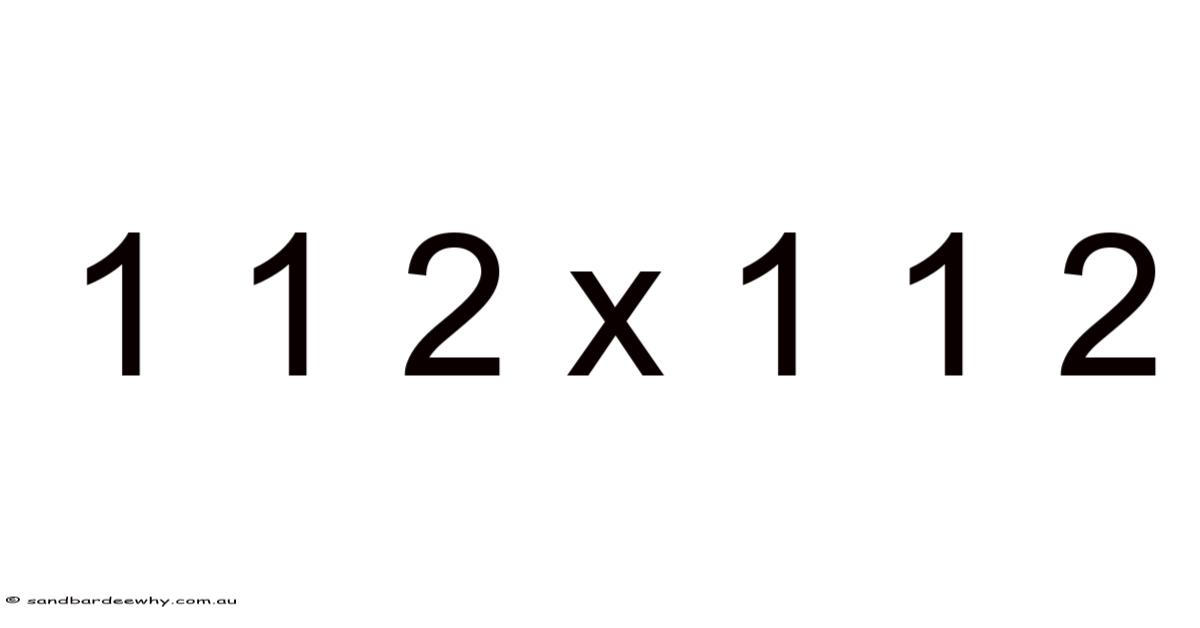
Imagine you're a woodworker tasked with crafting a beautiful tabletop. Think about it: the design calls for precise dimensions, and you need to calculate the exact area of the wood you'll be using. The specifications list the dimensions as 1 1/2 feet by 1 1/2 feet. So how do you approach this calculation? You could convert the mixed numbers to decimals, but that feels clunky and prone to error. The real key is understanding how to confidently and accurately multiply mixed numbers Easy to understand, harder to ignore. Turns out it matters..
Some disagree here. Fair enough.
Or perhaps you’re a home cook, scaling up a beloved cookie recipe for a bake sale. And the original recipe calls for 1 1/2 cups of flour, but you need to make three times the amount. Quickly, you realize that calculating 1 1/2 x 3 is essential. It's not just about getting the quantity right; it's about ensuring the final product tastes as delicious as intended. Understanding how to accurately multiply mixed numbers is a fundamental skill in both the kitchen and countless other practical scenarios. So, let's dive deep into the world of multiplying mixed numbers!
Mastering the Multiplication of Mixed Numbers: A practical guide
Multiplying mixed numbers might seem daunting at first glance, but with a systematic approach, it becomes a straightforward process. This guide will break down the steps, providing you with the knowledge and practice you need to confidently tackle any multiplication problem involving mixed numbers. From converting mixed numbers to improper fractions to simplifying the final answer, we will cover all essential aspects Worth keeping that in mind. That alone is useful..
Easier said than done, but still worth knowing.
Comprehensive Overview
To master the multiplication of mixed numbers, it’s crucial to first understand the underlying concepts and definitions. Let's explore these foundations:
What are Mixed Numbers?
A mixed number is a number that combines a whole number and a proper fraction. Here's one way to look at it: 2 1/4, 5 3/8, and 1 1/2 are all mixed numbers. The whole number part represents complete units, while the fractional part represents a portion of a unit. Understanding this combination is crucial for accurately performing arithmetic operations on mixed numbers Small thing, real impact. Simple as that..
Not the most exciting part, but easily the most useful Simple, but easy to overlook..
What are Improper Fractions?
An improper fraction is a fraction where the numerator (the top number) is greater than or equal to the denominator (the bottom number). Examples of improper fractions include 5/3, 8/8, and 11/4. Unlike proper fractions, which represent values less than one, improper fractions represent values greater than or equal to one No workaround needed..
The Importance of Converting Mixed Numbers to Improper Fractions
The key to easily multiplying mixed numbers lies in converting them into improper fractions. Multiplying fractions is much simpler than multiplying mixed numbers directly. When you convert to improper fractions, you're essentially expressing the entire quantity as a single fraction, which allows for straightforward multiplication of the numerators and denominators.
The Step-by-Step Conversion Process
To convert a mixed number to an improper fraction, follow these steps:
- Multiply the whole number by the denominator of the fraction.
- Add the result to the numerator of the fraction.
- Write the sum as the new numerator, keeping the same denominator.
To give you an idea, let’s convert the mixed number 3 2/5 to an improper fraction:
- Multiply the whole number (3) by the denominator (5): 3 x 5 = 15
- Add the result (15) to the numerator (2): 15 + 2 = 17
- Write the sum (17) as the new numerator, keeping the same denominator (5): 17/5
So, the improper fraction equivalent of 3 2/5 is 17/5 Less friction, more output..
Multiplying Improper Fractions: A Simple Procedure
Once you have converted all mixed numbers to improper fractions, the multiplication process is straightforward:
- Multiply the numerators together to get the new numerator.
- Multiply the denominators together to get the new denominator.
As an example, let's multiply 2/3 by 4/5:
- Multiply the numerators: 2 x 4 = 8
- Multiply the denominators: 3 x 5 = 15
The result is 8/15.
Simplifying the Result
After multiplying the improper fractions, you may need to simplify the resulting fraction. This involves reducing the fraction to its simplest form by dividing both the numerator and denominator by their greatest common factor (GCF).
To give you an idea, consider the fraction 12/18. The GCF of 12 and 18 is 6. Dividing both the numerator and the denominator by 6, we get:
12 ÷ 6 = 2 18 ÷ 6 = 3
Thus, the simplified fraction is 2/3.
Converting Improper Fractions Back to Mixed Numbers
In many cases, particularly in practical applications, you'll want to convert the resulting improper fraction back into a mixed number. This provides a more intuitive understanding of the quantity.
To convert an improper fraction to a mixed number, follow these steps:
- Divide the numerator by the denominator.
- The quotient (the whole number result of the division) becomes the whole number part of the mixed number.
- The remainder becomes the numerator of the fractional part, keeping the same denominator.
To give you an idea, let's convert the improper fraction 17/5 back to a mixed number:
- Divide the numerator (17) by the denominator (5): 17 ÷ 5 = 3 with a remainder of 2.
- The quotient (3) becomes the whole number part of the mixed number.
- The remainder (2) becomes the numerator of the fractional part, keeping the same denominator (5).
Which means, the mixed number equivalent of 17/5 is 3 2/5 Worth keeping that in mind..
Trends and Latest Developments
While the fundamental principles of multiplying mixed numbers remain constant, the way we approach these calculations has evolved with technological advancements and shifts in educational practices. Here are some notable trends and developments:
Increased Emphasis on Conceptual Understanding
Modern mathematics education places a greater emphasis on understanding the "why" behind the procedures, rather than just memorizing steps. Which means this means that students are encouraged to visualize and manipulate fractions and mixed numbers using concrete models, such as fraction bars and number lines, to develop a deeper understanding of their meaning. This approach helps students avoid rote memorization and apply their knowledge more flexibly in different contexts.
Integration of Technology
Calculators and computer software have become increasingly integrated into mathematics education and professional practice. Now, while it’s important to understand the manual calculation methods, technology can be used to verify answers, explore complex problems, and save time in real-world applications. Many online tools are available that allow you to easily multiply mixed numbers, convert between mixed numbers and improper fractions, and simplify fractions Less friction, more output..
Real-World Applications and Problem-Solving
There is a growing emphasis on connecting mathematical concepts to real-world applications. This helps students understand the relevance of what they are learning and motivates them to engage with the material more deeply. Examples of real-world applications of multiplying mixed numbers include:
- Cooking and Baking: Scaling recipes, adjusting ingredient quantities.
- Construction and Carpentry: Calculating material needs, measuring dimensions.
- Finance: Calculating interest, determining proportions of investments.
- Engineering: Designing structures, calculating forces and stresses.
Alternative Methods and Visual Aids
Educators are exploring alternative methods for teaching fraction multiplication, such as using area models and visual representations. But area models, for instance, can help students visualize the product of two fractions as the area of a rectangle. These visual aids can make the concept more accessible and intuitive for students who struggle with abstract mathematical concepts.
The Importance of Estimation
Before performing any calculation, it's good practice to estimate the answer. You can check the reasonableness of your final result and catch any potential errors because of this. And for example, if you are multiplying 2 1/2 by 3 1/4, you can estimate that the answer will be close to 2 x 3 = 6 or 3 x 3 = 9. If your calculated answer is significantly different from this estimate, it's a sign that you may have made a mistake But it adds up..
This is the bit that actually matters in practice.
Tips and Expert Advice
Here are some practical tips and expert advice to help you master the multiplication of mixed numbers:
Tip 1: Practice Regularly
Like any skill, mastering the multiplication of mixed numbers requires consistent practice. Dedicate time each day or week to work through a variety of problems. Start with simple examples and gradually increase the difficulty as you become more confident. Regular practice will help you internalize the steps and improve your speed and accuracy Worth keeping that in mind..
- Real-World Example: When baking, try doubling or tripling recipes that involve mixed numbers. This not only reinforces your math skills but also results in delicious treats!
- Pro Tip: Use online resources and worksheets to find a wide range of practice problems. Many websites offer customizable worksheets that allow you to generate problems meant for your skill level.
Tip 2: Understand the "Why" Behind the Steps
Don't just memorize the steps for converting mixed numbers to improper fractions and multiplying. Worth adding: take the time to understand why these steps work. Understanding the underlying concepts will help you to apply the procedures more flexibly and confidently in different situations.
- Real-World Example: Visualize converting a mixed number like 1 1/2 into an improper fraction (3/2). You're essentially seeing that one and a half is the same as three halves.
- Pro Tip: Use visual aids like fraction bars or diagrams to represent mixed numbers and improper fractions. This can help you to develop a deeper understanding of their relationship.
Tip 3: Simplify Before Multiplying
Look for opportunities to simplify fractions before you multiply. On the flip side, this can significantly reduce the size of the numbers you are working with and make the calculation easier. Simplifying involves finding common factors in the numerators and denominators and dividing them out And it works..
You'll probably want to bookmark this section Worth keeping that in mind..
- Real-World Example: If you are multiplying 4/6 by 3/2, you can simplify 4/6 to 2/3 by dividing both the numerator and denominator by 2. Then, you can simplify 3/3 to 1. This leaves you with 2/1 x 1/2, which is much easier to calculate.
- Pro Tip: Train yourself to quickly identify common factors in numerators and denominators. This will become second nature with practice.
Tip 4: Check Your Work
Always check your work to ensure accuracy. This is especially important in situations where errors can have significant consequences, such as in construction or finance.
- Real-World Example: If you are calculating the amount of lumber needed for a project, double-check your calculations to avoid wasting materials.
- Pro Tip: Use a calculator to verify your answers, but don't rely on it blindly. Make sure you understand the steps you are performing and that the calculator's result makes sense in the context of the problem.
Tip 5: Break Down Complex Problems
If you are faced with a complex problem involving multiple mixed numbers, break it down into smaller, more manageable steps. This will make the problem less daunting and reduce the likelihood of errors.
- Real-World Example: If you need to calculate the area of a room that is made up of multiple rectangular sections, calculate the area of each section separately and then add them together.
- Pro Tip: Use parentheses to group the steps in your calculations and see to it that you are performing the operations in the correct order.
FAQ
Q: What is the first step when multiplying mixed numbers?
A: The first step is always to convert the mixed numbers into improper fractions. Still, the result? You get to multiply the fractions easily.
Q: Why do we convert mixed numbers to improper fractions before multiplying?
A: Converting to improper fractions simplifies the multiplication process. It allows you to treat the entire quantity as a single fraction, making the multiplication of numerators and denominators straightforward Nothing fancy..
Q: How do I simplify a fraction after multiplying?
A: To simplify a fraction, divide both the numerator and the denominator by their greatest common factor (GCF). This reduces the fraction to its simplest form Simple, but easy to overlook..
Q: What if my answer is an improper fraction?
A: If your answer is an improper fraction, you can convert it back to a mixed number to provide a more intuitive understanding of the quantity And it works..
Q: Can I use a calculator to multiply mixed numbers?
A: Yes, calculators can be helpful for multiplying mixed numbers, but it helps to understand the underlying principles and check the calculator's result to ensure it makes sense in the context of the problem.
Conclusion
Mastering the multiplication of mixed numbers is a valuable skill that has numerous practical applications in everyday life. But by understanding the fundamental concepts, following the step-by-step procedures, and practicing regularly, you can confidently tackle any multiplication problem involving mixed numbers. Plus, remember to convert mixed numbers to improper fractions, multiply the numerators and denominators, simplify the result, and convert back to mixed numbers if needed. Keep practicing, and you'll soon find yourself confidently navigating the world of fractions!
Now that you’ve explored the intricacies of multiplying mixed numbers, it’s time to put your knowledge into practice! That's why try solving a few problems on your own, or find real-world applications where you can use this skill. Share your experiences or any questions you may have in the comments below – let’s learn and grow together!
This is the bit that actually matters in practice Simple as that..
